Why Compression Molding Simulation?

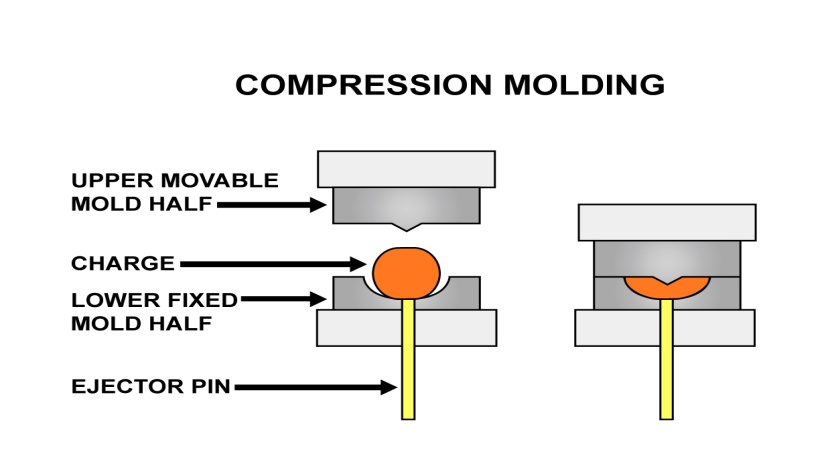
Compression Molding is a process in which the molding polymer, called charge or compound, is squeezed into a preheated mold to form the shape of the mold cavity with heat and pressure until the charge has cured. The process is suitable for parts that require complex geometry, high strength and high impact resistance. There are four types supported, Compression Molding, Embedded Wafer Level Package, No Flow Underfill (NFU), and Non Conductive Paste (NCP), examined the molding behavior on stacked-die and substrate under the compression force effect. Its main benefits are high-volume production and low costs.

Challenges

  • How to reduce the bonding height, warpage and die shift
  • High costs of Packaging and Testing
  • High filler content increased to impact the viscosity and flow

What Can Moldex3D Do?

  • Visualizes the filling behavior inside flip chip in the compression molding process
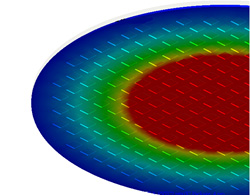
  • Evaluates the changes of melt thickness during the compression molding process
  • Supports wire sweep and particle tracking analysis simulation
  • Predicts Powder Concentration of filler content
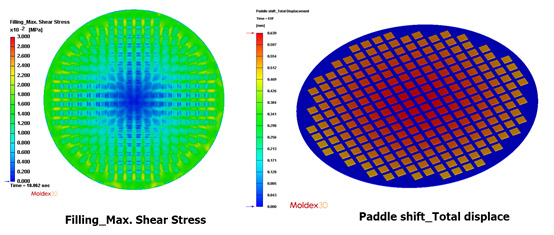
  • Evaluates visible expressions between actual die shift behavior and maximum shear stress distribution
Applicable Industries

IC Packaging

Applicable Moldex3D Package

Moldex3D Advanced Package
Why Compression Molding?

Compression Molding is a process in which a molding polymer, called charge or compound, is squeezed into a preheated mold cavity under heat and pressure until the charge has cured. The process is a high-volume-production and low-cost molding method, suitable for parts with complex appearance, high strength, or high impact resistance.

Compression Molding001
Compression molding enables the production of complex composite components at fast rate, Moldex3D supports many discontinuous FRP materials that frequently used in compression molding including thermoplastics material GMT, LFT-G and LFT-D. Thermoset type is also supported by Moldex3D, such as SMC and BMC materials.

Challenge

  • Proper amount of material
  • Predict the required force to ensure that shot attaining the proper shape
  • Provide appropriate compression parameters to assure quality compression effects
  • Design the mold for heating or cooling after the material has been compressed into the mold
  • Detect potential flash issue
  • Achieve product consistency control

What Can Moldex3D Do?

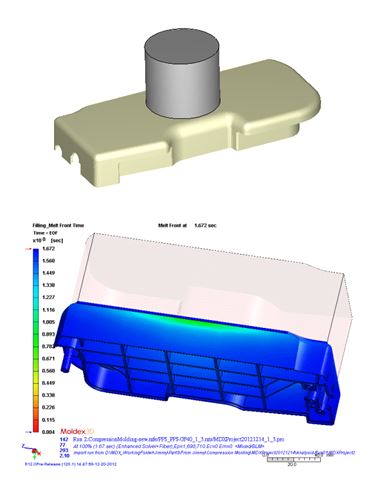
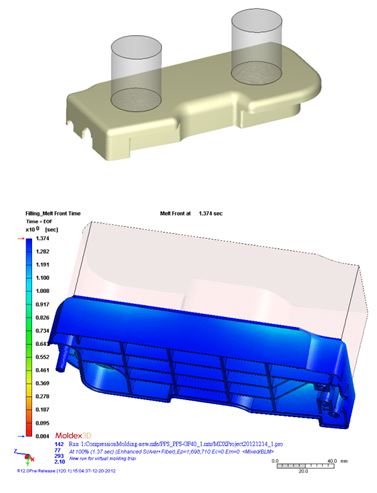
  • Simulate the filling process with single or multiple charge design
  • Visualize pressure distribution, volume shrinkage, residual stress, fiber orientation distribution, etc.
  • Predict potential molding defects, such as bleeding or flashing
  • Optimize process conditions, such as compression speed, force, or mold temperature
  • Support fiber orientation analyses
  • Support parallel processing to speed up the simulation
  • Support the molding simulation of single or multiple charge design

Compression Molding002

One-Charge Design

Two-Charge Design
  • To fulfill more accurate prediction of large deformation during compression molding process, Moldex3D can support LS-Dyna (R15.0 and newer versions). This integration allow user to seamlessly import initial temperature that calculated by LS-Dyna in initial charge deformation process for next compression molding analysis in Moldex3D. The key feature are
    • Support LS-Dyna material card that enable large deformation prediction with EFG method.
    • Allow user to import initial temperature calculated by LS-Dyna.
    • Allow user to define fiber orientation of initial charge.

Applicable Industries

  • Automotive
  • Electronics
  • Consumer Product

Applicable Moldex3D Package

  • Moldex3D Advanced package

Test drive Moldex3D

Join the thousands of companies using Moldex3D

Talk to Sales

Schedule a product demo with our sales team