

- Customer: Institute of Polymers and Composites (IPC), University of Minho
- Industry: Educational/Academy, Research Institute/Government
- Solution: Cool, Conformal Cooling
The Institute of Polymers and Composites (IPC) has been, since 2006, a Research Unit of the University of Minho (UMinho) that aims to address industrial and societal needs and challenges in the fields of polymer and composite science and technology.
Transforming Iterative Trial-and-Error into Structured Search
At the Institute for Polymers and Composites (IPC) at the University of Minho, researchers leverage simulation and artificial intelligence (AI) to tackle one of the most persistent bottlenecks in injection molding: achieving fast, uniform cooling without compromising quality. By adopting a simulation-first workflow, completed by PCA-based objective selection, Artificial Neural Network (ANN) surrogate modeling, and multi-objective evolutionary optimization, the team has transformed weeks of traditional trial-and-error into a structured, data-driven search for the best mold and process designs.
Simulation and AI as Enablers of Better Design Decisions
Cooling typically accounts for 70%-80% of the entire injection molding cycle time, making it a primary driver of residual stress, warpage, and displacement. While Conformal Cooling Channels (CCC) help mitigate these issues, the layout of conformal cooling channels can be a multi-objective problem involving cycle time, temperature uniformity, and manufacturability.
To address this, the IPC team utilizes Moldex3D to evaluate designs and leverages AI to navigate the trade-space. This approach allows the team to consistently obtain designs with markedly better temperature fields and shorter cycle times compared to conventional straight-drilled layouts.
Application Spotlight: Thin-Wall Cup with Conformal Cooling
To illustrate this methodology, the IPC team demonstrated a thin-wall cup case study. Moldex3D was employed to evaluate channels’ placement, diameter, and spacing, while AI pruned the search and highlighted high-value designs. By adopting this workflow, the team successfully reduced the predicted cycle time relative to conventional layouts, proving that the combination of CCC and AI turns “hard-to-tune” into “easy-to-justify.”
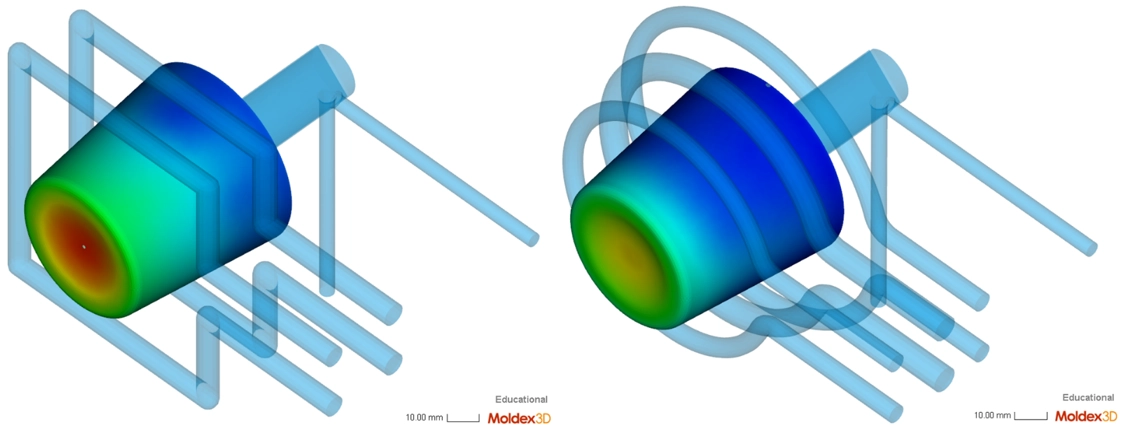
Fig. 1 Example: Design of Conformal Cooling Channels (CCC.)
Inside the IPC Team’s Workflow
Injection molding projects often involve tracking dozens of metrics. The IPC team applies Principal Component Analysis (PCA) to narrow down objectives without losing the essence of the problem. Moreover, the team builds ANN surrogate models, trained by Moldex3D simulation results, to quickly predict temperature uniformity and cooling time. The team than employs Multi-Objective Evolutionary Algorithms (MOEAs) to efficiently explore thousands of feasible designs, using Moldex3D to verify the most promising options. Finally, they generate a Pareto front, instead of a single “optimum,” to clearly show the trade-offs. For example, how much cycle time to give up for tighter temperature homogeneity.
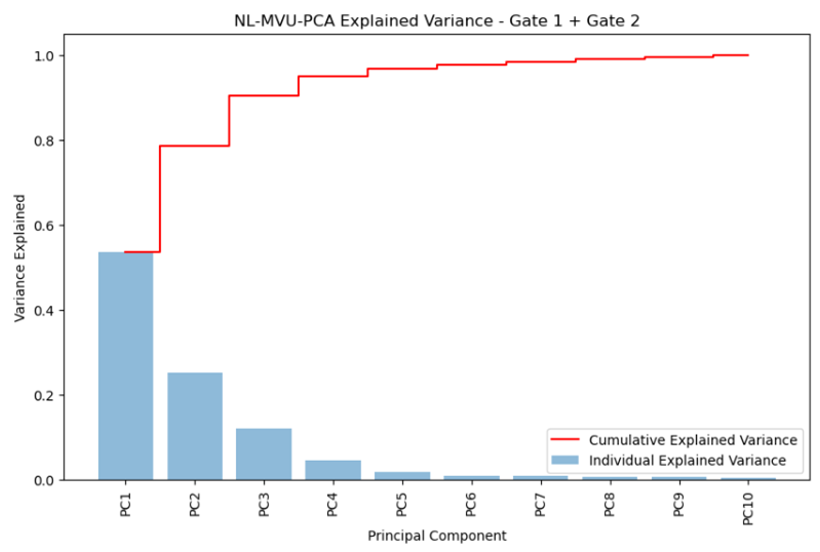
Fig. 2 Application of Non-Linear Principal Component Analysis (NL-PCA) to select objectives for optimization.
AI as the Accelerator, Simulation as the Foundation
The IPC team validated the same methodology focused on multi-objective AI techniques for CCC design, reinforcing that this is a repeatable path to higher-quality molds and faster cycles, not a one-off experiment. While AI accelerates exploration, the necessity of physics-based simulation remains paramount. It provides accurate physics and material behavior that ground ANN and MOEA searches in reality. In addition, Moldex3D offers valuable 3D fiber, thermal, flow insights that help determine root causes (e.g. hot spot) and confirm final design choices. Most importantly, all optimization metrics are verified in Moldex3D before tooling, mitigating manufacturing risks and reducing production costs.
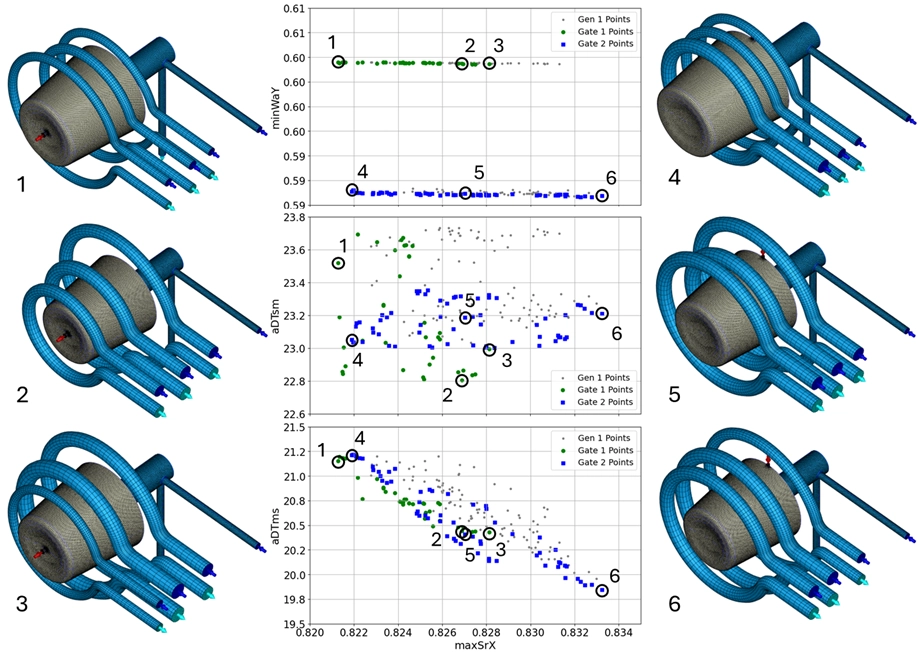
Fig. 3 Results obtained after the application of a MOEA considering two alternative gates and the four objectives selected by NL-PCA.
References to IPC’s Work:
- Gaspar-Cunha, Melo, Marques, Pontes. Methodology for Designing Injection Molds: Data Mining and Multi-objective Optimization. In: Applications of Evolutionary Computation (LNCS, 2025). SpringerLink
- Gaspar-Cunha, Melo, Marques, Pontes. Optimization of Conformal Cooling Channels for Injection Molding: Multi-Objective AI Techniques. GECCO 2025. ACM Digital Library+1
- Gaspar-Cunha, Melo, Marques, Pontes. Application of AI Techniques to Select the Objectives in the Multi-Objective Optimization of Injection Molding. International Polymer Processing, 40(3), 2025. De Gruyter Bril